
Machine Safety Audits Selection Guide
Choose a machinery review by its asset/task boundary, evidence and limitations, traceable findings, action ownership, further-assessment needs and closure criteria.
Compare review scopes using the same asset list, interfaces and actual tasks. Ask which records and operating modes can be reviewed, what findings will be delivered and which omissions or technical questions remain. Agree priorities, owners and closure evidence, keeping initial review and subsequent remedial engineering responsibilities clear.
Use the same machine and task brief with the same action-closure criteria. Retain the detailed scope guidance below. A visual survey, control-system assessment and functional validation must not be presented as equivalent without the relevant evidence.
Compare options in the conditions where they must work — Machine Safety Audits
Plan machine safety audits around your machine hazards, operator tasks, access, stopping behaviour and validation evidence. Discuss a site-specific safeguarding concept with Oxford Machine Guarding. A useful shortlist should show how every option copes with hazards and foreseeable access for machine safety reviews & action plans and space, visibility and operator ergonomics.
Discuss your application
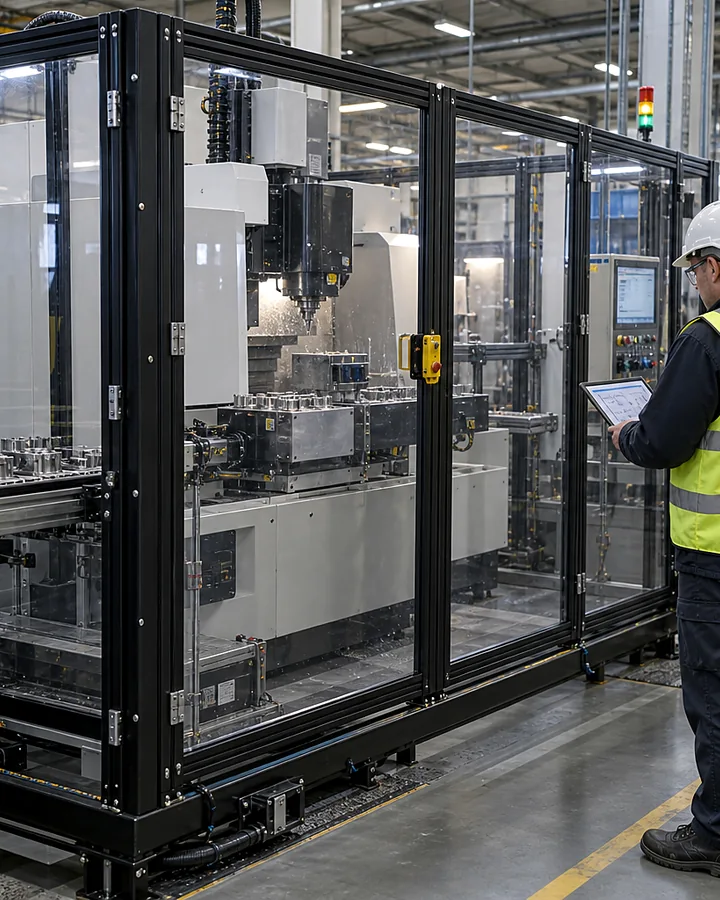
Ask every supplier the same questions
| Decision | What to ask | What to check |
|---|---|---|
| Assets and connected interfaces | Which machines, locations and connections are included or omitted? | Asset/layout references and an explicit review boundary. |
| Actual tasks and access | Does the scope include setting, fault recovery, cleaning and maintenance? | Task/access record with operating modes and relevant site personnel. |
| Available evidence and gaps | Which manuals, drawings, prior assessments and modification records are current? | Referenced documents, assumptions, missing information and resulting limitations. |
| Traceable findings | Will each finding identify its machine, location, task and supporting evidence? | Observed conditions separated from assumptions and unresolved questions. |
| Actions and responsibilities | How will priorities, escalation, owners and review dates be agreed? | An action register with responsibilities and further-assessment needs. |
| Closure and changes | What evidence establishes completion, and who reviews it? | Inspection/assessment/validation records, changes during open actions and remaining limitations. |
Include simpler approaches to machine safety reviews and action plans in your shortlist
| Approach | Often suitable when | Watch for |
|---|---|---|
| Initial machinery review | The need is to identify findings and evidence gaps in a defined installed-machine scope. | Agree tasks, interfaces, omissions and action deliverables; do not imply unperformed technical validation. |
| Focused assessment of a change | An altered machine, task, interface or unresolved technical question needs attention. | Define the competent assessment and affected boundaries rather than treating every review as identical. |
| Verification of remedial work | Actions have been implemented and agreed closure evidence can be reviewed. | Retain results against the original finding and keep unresolved limitations visible. |
Pause before choosing when…
- Only perfect or hand-selected examples of safeguarding existing machinery for machine safety reviews and action plans are available.
- No one has defined how risk-reduction and validation evidence will be evaluated.
- The normal range for hazards and foreseeable access for machine safety reviews & action plans is described only as “usually fine” but has not been bounded.
- Your operator, cleaning, maintenance or recovery access has not been considered.
- Quoted performance depends on another machine or data source that is not included.
Choose an audit by the decisions its findings support
A machine list and a completed checklist are useful inputs, but the important deliverable is a traceable route from observed conditions to agreed actions. Define that route when comparing the scope of a machinery safety review.
State the boundary of each review
Record the individual machine, connected equipment and tasks included. Distinguish a visual survey from a control-system assessment or validation activity. If drawings, stopping measurements or access to a mode are unavailable, have the report identify the resulting limitation rather than implying the missing area was verified.
Separate observations from conclusions
A useful finding identifies the location, task and observed condition, together with the evidence and the question it raises. Ask for photographs or drawing references where appropriate. Generic statements such as improve guarding do not tell an engineer which hazard and access route the proposed work must address.
Assign actions with a closure test
For each action, agree the responsible role, priority, interim controls where needed and what evidence will establish completion. A purchase order for a guard is not the same as a checked installation. Keep design, installation and verification responsibilities visible so an action does not disappear between teams.
Control what changes after the visit
Record machine or process changes made while actions remain open. If tooling, access, operating modes or connected equipment changes, assess whether the original finding and proposed remedy still apply. Retain the final evidence with the machinery records rather than relying on an untracked email saying the item is closed.
Review machine safety audit scope
Further reading: HSE inspection guidance, HSE risk assessment.